Field Guide · Notebook I
Saint Catherine's lace, Eriogonum giganteum
Saint Catherine's lace is the tree buckwheat of the Channel Islands, a grey fountain that carries dinner plate heads of cream flowers above dry garden gravel.
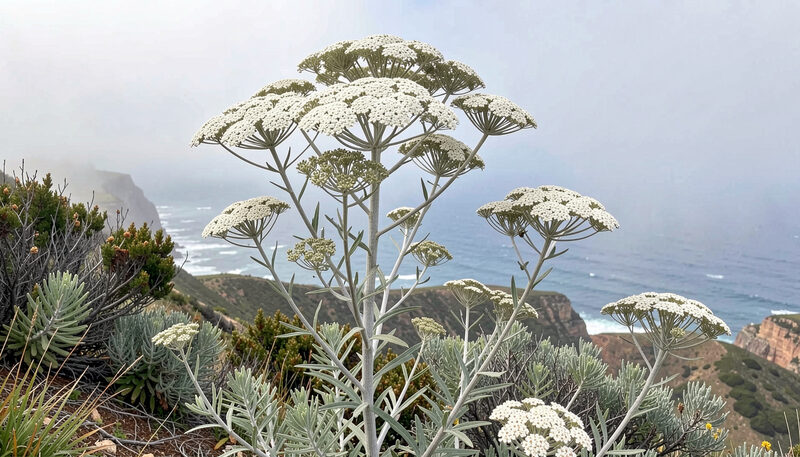
Saint Catherine's lace, Eriogonum giganteum, is the giant of the genus: a buckwheat that grows into a small tree, veiled in June beneath flower heads as wide as dinner plates. It comes from the Channel Islands off the southern California coast, those foggy, goat bitten rocks where plants often grow larger and stranger than their mainland cousins, and it carries the island rule perfectly. In a mediterranean garden it makes an architectural grey fountain three metres tall, humming with insects, asking for nothing but sun and drainage.
For gardeners who know the low domes of sulfur buckwheat or the chaparral rounds of California buckwheat, this species answers the obvious next question: how big does the genus get? The answer is tree sized, and the plant earns its place in gardens far outside its native islands.
The tree buckwheat of the Channel Islands
The species is native to several of the Channel Islands, including Santa Catalina, the island once called Saint Catherine's, which gave the plant both its common and scientific names: giganteum for its size. On the islands it grows on bluffs and canyons in the company of other island endemics, shaped by salt wind and summer drought into a dense rounded crown. Like every Eriogonum it is built from the same small parts described in the introduction to the genus, just multiplied: the minute florets in their involucres are here massed by the thousand into broad, flat, compound heads that read as a single sheet of bloom from a distance.
What Saint Catherine's lace looks like
Close up, the plant is a study in pale grey. The leaves are broad, oval and densely white felted on both faces, and the young stems wear the same wool, so the whole shrub glows against dark walls or dry hills. The flower heads rise on rust red stems above the foliage, each head a compound umbel of cream to pale pink, often aging to rose. Flowering runs late spring into summer, and after bloom the heads dry to a lasting biscuit brown that holds the plant's shape until trimmed. The scale surprises every first time visitor: a mature specimen in open ground can reach three metres tall and as wide, with heads thirty centimetres across. Recognizing the family architecture at that size is good practice in the methods of the field identification guide.
Growing it away from the ocean
In gardens the species is honest about its needs. It wants full sun and the sharpest drainage in the garden, a mound or slope of gritty soil, and room, because it will not stay the small round shrub of its first spring. It tolerates inland heat well once established, and gardeners in hot interior valleys grow it against west facing walls where lesser plants scorch. Its one real limit is hard frost: the species comes from a maritime climate, and young plants in particular want protection where winters drop far below freezing. Planting follows the standard dry garden routine, cool season planting, gravel mulch, the crown kept high and dry, and the first summer watered deeply but rarely, all detailed in the guide to planting a dry garden. Growth is fast, so the wait for a flowering specimen is short.
Placement decides how the plant reads. Given room, a single specimen becomes a small tree with a clean grey trunk and a crown two people can stand under, the mediterranean garden's answer to an olive. Planted in groups of three on a slope, the crowns merge into a silver hedge that flowers as one surface. And at the back of a dry border it makes the tall pale scrim against which the darker genera, the sages and penstemons, show their color. Whatever the placement, the gardener should allow for the mature width from the start, because the species forgives staking and transplanting poorly once its crown widens, and a lace cut hard to fit a bed loses the very habit it was planted for.
A magnet for insects
When the lace blooms, the garden acquires a sound. The massed heads offer nectar by the square metre at exactly the season when the dry garden's other plants are winding down, and native bees, honeybees and small butterflies work it in shifts from morning to dusk. The shrub plays the same role inland that California buckwheat plays in the chaparral, a late season nectar station, and the two can be grown as companions where frost allows, extending the succession described in the guide to buckwheats for pollinators. After bloom, the dried heads feed seed eaters until trimmed, and the trim itself follows the light hand of the pruning guide.
How fast and how long?
The species grows quickly, reaching flowering size in two or three years from a young plant, and it keeps a generous open habit rather than tightening into old age. Left unpruned it becomes loose and slightly wild, which suits large mediterranean plantings, while an annual light shaping after bloom keeps the fountain form compact. Gardeners in dry climates often report decades of service from a single well sited specimen. Where scale is wanted sooner than a tree can give it, this buckwheat is one of the fastest legitimate routes to real architecture on no summer irrigation.
Give it the sunniest mound in the garden, plant it small in the cool season, and stand back. Few native plants deliver this much presence per litre of water, which on a dry coast is the only exchange rate that matters.