People and Pollinators · Notebook III
Buckwheats for bees, butterflies and late nectar
When little else flowers in the dry months, buckwheats hold the nectar line: bees, blue butterflies that live on one species, and hummingbirds on the hills.
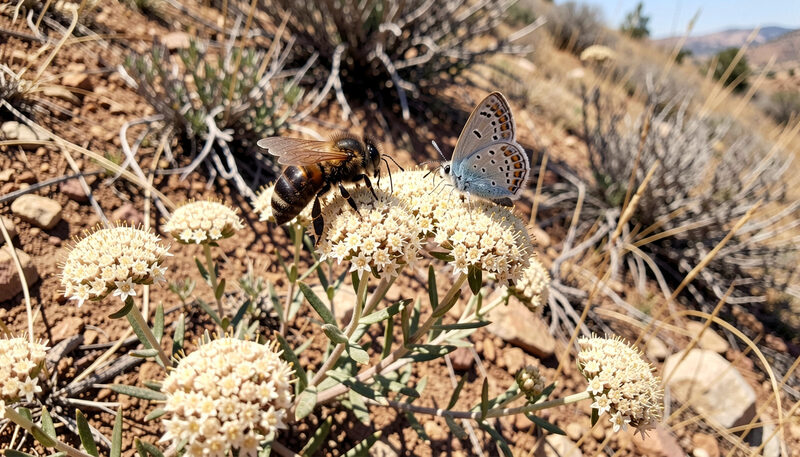
In the dry months, the hills of the American West lean on one genus. When annuals have finished and the chaparral waits motionless for rain, the buckwheats are still flowering, their pale heads standing over grey foliage like service stations on an empty highway. Native bees, honeybees, butterflies and hummingbirds all work them, and several butterflies do not merely visit buckwheats but live on them, caterpillars and all. This guide lays out the case for the genus as a wildlife plant: the nectar calendar, the specialist insects, and what a gardener who wants that life in the garden should plant.
The structure of the flower explains the traffic. Each minute floret offers nectar at a depth tiny insects can reach, and the massed heads put thousands of flowers within a short flight, so a shrub in full bloom is both cafeteria and crowd. The genus habits that make this architecture work are described in the introduction to wild buckwheats.
Nectar when nothing else flowers
The western dry season is a nectar famine. From late spring to autumn the annuals are spent, the bulbs long dormant, and most shrubs flower briefly and stop. Buckwheats run against that grain: California buckwheat flowers in flushes from spring well into the dry months, sulfur buckwheat holds montane August, and Saint Catherine's lace covers early summer at tree scale. Beekeepers in southern California know this schedule from the hive: the dark, strong honey their bees make from California buckwheat is a recognized monofloral harvest. In the garden the same schedule means something simpler, flowers present when the pollinators have nowhere else to go, which is exactly when a garden earns its place in the landscape.
Butterflies that live on buckwheats
Visiting is one thing; depending is another, and here the genus has no western equal among garden shrubs. The blue butterflies of the genus Euphilotes, the squarespots and dotted blues, are buckwheat specialists across the West: their caterpillars feed on the flower heads and leaves of Eriogonum species, and several of them are famous for being tied to a single buckwheat species across their whole range. The blue copper, a butterfly of higher and drier country, likewise feeds its caterpillars on buckwheat foliage. These are not casual relationships but addresses: remove the buckwheat and the butterfly's population goes with it, which is why native plant advocates in California describe the shrubs as keystone species. A gardener who plants the local buckwheat is not decorating; the gardener is restoring an address.
Native bees and the working heads
The heads also hum with bees, and not only honeybees. Native bees, the small dark miners, leafcutters and sweat bees that make up most of the western bee fauna, work buckwheat flowers in numbers through the driest weeks, when other forage has closed. Because many native bees forage over small ranges, a garden buckwheat can anchor a local population that then pollinates the vegetables and fruit trees nearby. The combination gardeners aim for is simple: one or two buckwheat species in continuous bloom, a patch of bare ground for the ground nesting miners, and no insecticides anywhere in the garden. Flowering herbs and annuals can extend the season at the edges, but nothing else in the dry garden carries August the way the buckwheats do.
A keystone of dry habitats
The wildlife argument compounds across the year. Spring feeds the first bee generations on the early heads. Summer carries the specialists. Autumn's rust brown heads, if left unpruned a few weeks past bloom, feed seed eating birds before winter, a habit noted in the pruning guide. The shrubs themselves shelter insects in their dense crowns, and their deep roots hold the slopes that everything else stands on. Ecologists and native plant societies increasingly talk this way about the genus, as a small number of plants that support a disproportionate share of life, and the buckwheats sit on that short list for the entire arid West. For the gardener, the practical translation is planting the local species rather than an exotic ornamental of equal beauty, because the local insects are keyed to it.
Bringing the pollinators home
The planting plan need not be large. One early species, sulfur buckwheat for colder gardens or California buckwheat for hot ones, one late species to hold August, and, where frost allows, one giant for scale and early summer. Site them by the rules of the dry garden planting guide, gravel, mound, dry crown, and start young plants cheaply by the methods of growing buckwheats from seed. The insects arrive the first season, often the first week, and the garden's quietest corner becomes its loudest.
The first step is the smallest: one buckwheat of the local species, planted this autumn, left to bloom through next summer without a drop of extra water. Everything with wings within a street's radius finds it.