Field Guide · Notebook I
What is a wild buckwheat?
Wild buckwheats are the genus Eriogonum, some 250 western North American shrubs and perennials with tiny flowers in cups, cousins of the pancake grain.
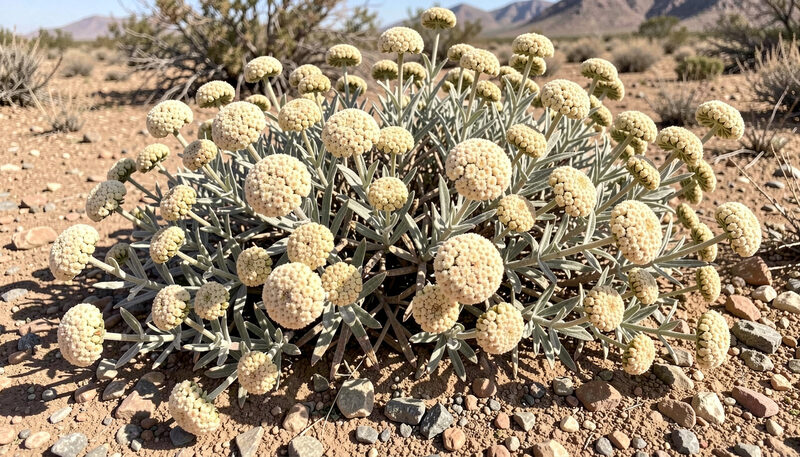
The wild buckwheats are the genus Eriogonum, a group of roughly two hundred and fifty species of shrubs, subshrubs, perennials and annuals that belong to the American West the way gum trees belong to Australia. From the sagebrush hills of the Great Basin to the granite slopes of the Sierra Nevada and the coastal scrub of California, a walker who learns to see this one genus starts putting names on a startling share of the dry landscape. This guide sets out what the genus is, where it grows, and why gardeners and naturalists keep returning to it.
The name invites a first confusion worth clearing at once: a wild buckwheat is not the plant that makes pancake flour. The two are cousins in the same family, the Polygonaceae, and their small three angled seeds look alike enough that early settlers reached for a familiar word. The cultivated buckwheat belongs to the genus Fagopyrum and came to North America from Asia. The wild buckwheats were here long before, and they stayed western.
A large genus of one family
Eriogonum sits in the Polygonaceae, the family that also counts rhubarb, sorrel and the knotweeds among its members. The family mark is easiest to see in the seed: a small dry achene with three angles, the shape that gave the cultivated grain its kitchen uses. Within that family the genus is exceptional for its size and its concentration in one region. Reference works such as the general account of the genus count about two hundred and fifty species, and almost all of them are native to North America, with the great majority west of the Rocky Mountains. California alone hosts a remarkable share of that diversity, which is why the state's floras give the genus so much room.
Why are they called buckwheats?
The common name came from resemblance and habit. The tiny flowers ripen into grain like seeds, and several western peoples and settlers gathered some species as wild seed food, so the comparison with the field crop was natural. Botanically the link is honest: both genera bear their flowers without the showy petals a gardener expects, and both carry their seeds in the same three angled package. But the cultivated plant is a fast annual of moist fields, while most wild buckwheats are long lived drought dwellers of stony ground. Any gardener who has drowned a buckwheat with kindness meets the difference quickly.
How do you recognize the genus at a glance?
Three habits do most of the identifying work. First, the flowers are minute, often no bigger than a grain of rice, and they sit inside little cups called involucres, several flowers to a cup, the cups then clustered into round heads or flat topped sprays. Second, many species hold their leaves in a basal rosette or in tight bundles along the stems, and the leaves are often felted with pale hairs below or on both faces, a silvering that reflects sun and slows water loss. Third, the bloom colors stay in a quiet band: cream, white, yellow, rose and rust, with many species shifting color as the flowers age. A reader who wants the full method can work through the step by step field identification guide, which turns these habits into a routine.
What forms does the genus take?
The range of habits inside one genus is part of its fascination. There are dainty annuals that germinate, bloom and die inside a single desert spring. There are herbaceous perennials that die to a crown each winter. There are the subshrubs and shrubs, often cushion or dome shaped, that make the skeleton of chaparral and sagebrush slopes. And there is a genuine tree: Saint Catherine's lace, Eriogonum giganteum of the Channel Islands, which grows into a grey fountain several metres tall. Few genera stretch from rock garden cushion to island tree while keeping the same small cupped flowers.
Where do wild buckwheats grow?
The genus follows dry country. Its heartland runs from the deserts and peninsular ranges of the south west through the Sierra Nevada and the Great Basin into the interior valleys and dry mountains of the north west, with species reaching British Columbia in one direction and Mexico in the other. Within that broad sweep, each species keeps a narrow address: sulfur buckwheat on granitic slopes, California buckwheat across the chaparral, island lace on sea bluffs. This fidelity to habitat is what makes buckwheats such good indicators on a walk, and what makes habitat the first clue in identification. The regional floras, for instance the OregonFlora treatment of the genus, map those addresses species by species.
Why gardeners care about a genus of dry hills
Where a wild plant has spent millennia learning to bloom on gravel, gardeners in dry climates pay attention. Buckwheats offer a rare combination: long seasons of subtle bloom, silvery foliage that carries the garden through August, deep roots that ask for almost no summer water once settled, and flowers that feed bees and butterflies precisely when little else is flowering. They are the backbone plants of the dry garden movement in the western states. The journal's dry gardens section covers the practice from seed to pruning, and the portraits of sulfur buckwheat and California buckwheat show the two species that appear in most western gardens first.
A first outing with the genus
No description replaces ten minutes on a dry slope in early summer. Choose a walk with open sagebrush or chaparral between June and August, go slowly, and look low. Find a shrub with round heads of cream or yellow flowers, turn one flower cluster over, and look for the little cups that hold each floret. Feel the leaves for the felt. Photograph the whole plant, a single head, and the ground it stands on, and the pictures will carry most of what a flora asks for. That modest routine, repeated on a few walks, teaches the genus faster than any catalogue, and it turns every future hike in the West into a meeting rather than a blur.